


Called to Life: Covenant Love, Choice, and the Heart of Yahweh (God)
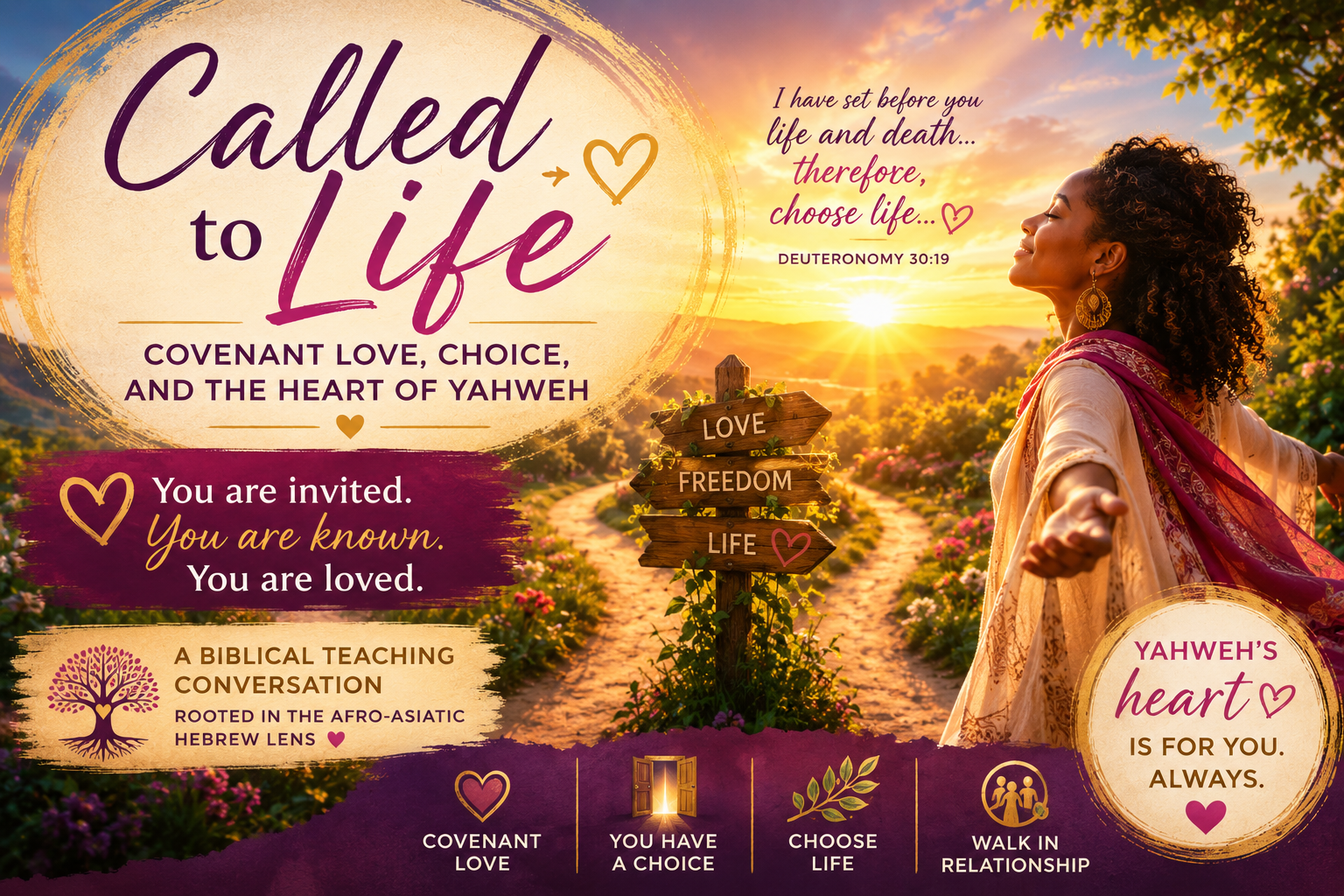
This blog sets the tone for everything that follows. At its heart, this series is an invitation — to know Yahweh (God) more deeply, to understand His covenant love, and to explore what it truly means to walk in relationship with Yeshua (Jesus). Four ideas will guide us through that journey:
- Invitation — "Called to Life"
- Theology — "Covenant Love"
- Responsibility — "Choice"
- Relationship — "The Heart of Yahweh"
A Question Many Carry in Silence
There is a question many of us carry quietly, even if we never say it out loud: Does Yahweh (God) still love me when I've made decisions I can't undo? Not the polished version of you or me. Not the version that gets it right. But the version of each of us who knows where we have misstepped… the one still living with the consequences of our own choices—good or bad.
What Covenant Love Really Means
From an ancient Hebrew perspective, love was never understood as shallow acceptance or passive approval. It was covenant. Covenant is not a fleeting emotion. It is a binding, relational commitment rooted in loyalty, responsibility, and purpose. When Yahweh sets His love on you and me, it is not withdrawn when we stumble. It is not diluted when life becomes complicated. And it is not confused by seasons of failure or success. But covenant love must be understood in its fullness.
Unwavering, But Not Careless
Yahweh's love is unwavering, but it is not careless. In many modern conversations, love is often reduced to unconditional acceptance without expectation. Yet within the Afro-Asiatic, Hebraic framework, love and accountability were never separated. To love someone was to remain committed to them, yes, but also to uphold the integrity of the relationship itself.
The Dignity of Your Choices
Yahweh's love does not erase the dignity of your choices. He allows you to choose your path to build or to neglect, to walk in wisdom or to step outside of it. And with that freedom comes something many wrestle with: consequence. Not as punishment in the shallow sense, but as the natural outworking of decisions.
When Consequences Feel Like Distance
This is where many misunderstand our Father’s (Yahweh’s) heart. When consequences come, it can feel like distance. It can feel like silence. It can even feel like rejection. But from the ancient lens, it is often something else entirely. It is Yahweh honoring the very agency He gave to humanity, while still remaining present within the outcome. He does not abandon you to your decisions. He meets you within them. This is what makes His love both powerful and sobering. Because real love does not control; it invites. It does not force alignment; it calls you back to it. And it does not permit "anything" to define the relationship; it maintains its integrity, even when we drift. So yes, Yahweh’s love is unshakable. But your experience of that love will often be shaped by the direction you choose. Not because His love changes, but because relationship, by its very nature, is lived out in motion. And even there; especially there, He is still calling us higher.
Can a Person Choose Separation from Yahweh?
This is where many wrestle with one of the hardest questions: Will Yahweh allow someone to choose separation from Him (what many call hell)? From the ancient Hebrew lens, the focus was never on a distant place as much as it was on relationship or the absence of it. Yahweh does not force love and He does not override the will He Himself established. If love is to be real, it must include the possibility of refusal. So yes, He allows choice, even when that choice leads to separation. But that reality should not be understood as a desire to lose you. It is the extension of the same covenantal love that gives dignity, agency, and responsibility. A love that invites, calls, warns, and reaches—again and again—but does not coerce. Even in this, Yahweh remains consistent. He is not eager for distance. He is not indifferent to loss. And He is not absent in His pursuit. But He will not force what must be freely given. Which means the question is not simply whether hell is chosen; but, whether a person will ultimately respond to the One who continues to call him into life.
What Scripture Says About His Heart
Yahweh has never been silent about His heart. Through the voices of the prophets and the writings of old, He speaks with clarity; holding both love and responsibility together: "I have set before you life and death, blessing and curse. Therefore choose life, so that you and your descendants may live." (Deuteronomy 30:19) "The one who sins is the one who will die… Repent and live." (Ezekiel 18:20, 32) "As surely as I live," declares Yahweh, "I take no pleasure in the death of the wicked, but rather that they turn from their ways and live." (Ezekiel 33:11) And even in moments of distance, His invitation remains: "You will seek Me and find Me when you search for Me with all your heart." (Jeremiah 29:13)
The Rhythm of Covenant
This is the rhythm of covenant. Yahweh sets the path. He honors your choice. He establishes boundaries. And still—He calls you toward life. Always toward life.
*Reflection Prayer*
Yahweh, thank You for calling me to life, not through fear or obligation, but through Your covenant love. Thank You for creating me with the freedom to choose and for continually inviting me into deeper relationship with You.
Help me to recognize Your heart—a heart that is patient, merciful, faithful, and full of compassion. Teach me to choose life each day, to walk in Your ways, and to trust that Your invitations are always rooted in love.
May I rest in the assurance that I am seen, known, and cherished by You. Shape my heart to reflect Your love so that others may also experience the beauty of being welcomed into Your covenant embrace.
In Yeshua's (Jesus') Name,
Amen.
Cheribu Community Reflections
We’d love to hear your reflections! Share your thoughts via email at cheri@cheribu.com or use the website connect form (Home page or Contact page). Each month, we feature these reflections in our Cheribu Community Reflections newsletter—so you can see how others are connecting with our blogs and music!